|
C-FUSION happen!
Will
software be able to mimic a polymerisation reaction within a
few seconds and provide you with information that will
be difficult to obtain otherwise?
The answer is: yes, with
C-Fusion. This -recently developed- tool will help
you to design polymers, made by stepwise polymerisation
reactions. It is able to create randomly chosen links
between virtual particles located in a list. It was designed
to give a large amount of
information with a high reliability within a short time span.
A Monte Carlo based simulator is able to
give reliable information about many different processes.
A drawback of this type of simulators is that a large
amount of data is produced. This makes looking for the
relevant data very complicated. In C-Fusion all data that are
produced are easy available and transportable to a
spreadsheet. Moreover, within C-Fusion almost all results are
displayed in detailed plots. They may contain distributions of
Molecular weight, functional groups, and fragments. It is also
possible to look at graphical representations of molecular
backbones, development of the polydispersity and approaching
of the gelpoint.
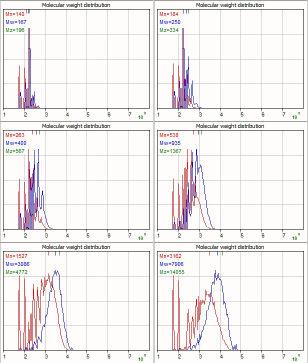
During a calculation period you
will C-Fusion: the development
of the molecular weight distribution, functionality,
polydispersity, and average molecular weight in 4 plots that
will be updated continuously. This feature will not only be
useful within research projects but also for educational
purposes.
C-Fusion can be extremely useful in case there
is doubt if a product is compliant with the polymer
definition. If the product is not compliant, it must be
registered according to REACH legislation. C-Fusion has a
feature that automatically determines whether the result
of the simulation is compliant or not.
Compared to the current generation of simulators, some
extra
features are:
- detailed graphics
to give a better notion,
- a way to detect unreacted
material and oligomers,
- a feature to check the polymer
definition,
- a backbone viewer to get an impression of the
molecular structures,
- real time update of graphs during
the simulation,
- an inviting and user friendly
workspace,
- creation of reports in Excel workbook
format,
- an easy way to get detailed control on the
reactivity of your ingredients,
- ...
CONCEPT

P,Q organic groups; A,B
reactive groups; C distillate, A< >B. (head tail
reactions are not supported)
- Random collisions between reactive
groups will create bonds.
- Very large statistical sample &
a unique combination of statistics and
probability
FEATURES
Software
-
Supported
platforms: Windows NT/2000/XP/Vista/7/8/10.
-
Real
time visualization and updating of mwd development during
the simulation.
-
Visualization
of branched structures will give an increased understanding
in the structure of polymer molecules that where created
during the simulation.
-
Very
large statistical samples (>10 M) cause a unique
combination of statistics and probability.
-
Fast
processing time (~10 sec. for a 150K sample on a
Pentium IV)
-
The
reactivity of each functional group can be
adjusted.
-
Supports
any raw material of any functionality.
-
Easy
transfer of data to Excel.
-
One
does not need to have a high education in chemistry to
understand and work with
C-Fusion.
-
C-Fusion
is both reliable and validated (see below)
Chemistry
-
Determination
of monomer sequences in polymer chains.
-
Estimation
of compliancy with the polymer definition
(REACH)
-
Reactivity
of functional groups can be tailored to match experimental
data.
-
Supports
polycondensations, ring opening reaction kinetics and chain
extension reactions.
-
End-group
and gel point prediction.
-
Simulates
reactions up to max Mw approx. 100.000 K.
-
Estimate
the concentration of oligomers and unreacted
monomer.
-
Estimate
the presence of user defined fragments.
-
Determine
Mn, Mw and Mz.
-
Determine
weight and functionality distribution.
-
Study
the reaction rate as a function of aforementioned
features.
-
Determination
of the reaction rate in combination with NMR end-group
analysis.
-
Investigate
theories related to polymer
branching.
RELIABILITY
Among the several tests that were
conducted, comparing a simulated molecular weight distribution
with experimental data was one of the most obvious.
The picture below gives an impression
about how reliabile the output of C-Fusion is. A simulated
molecular weight distribution was compared with the SEC
results of a real synthesis based on the same recipe (though
compensated for glycol losses) as used in the
simulator. Where SEC only produces one distribution, the
simulator produces both number and weight
distribution.
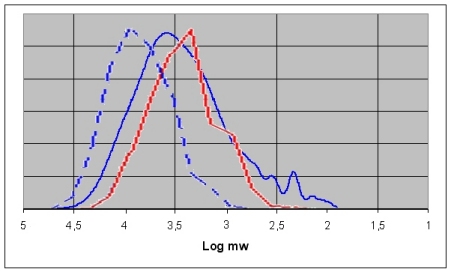
Blue : SEC
Red : simulated Number distribution
Dotted blue : simulated Weight distribution
VALIDATION
NPLCxSEC-UV/HRMS: Technology developed at University of Amsterdam in 2019.
Combined analysis of SEC, endgroups and content of branching material.
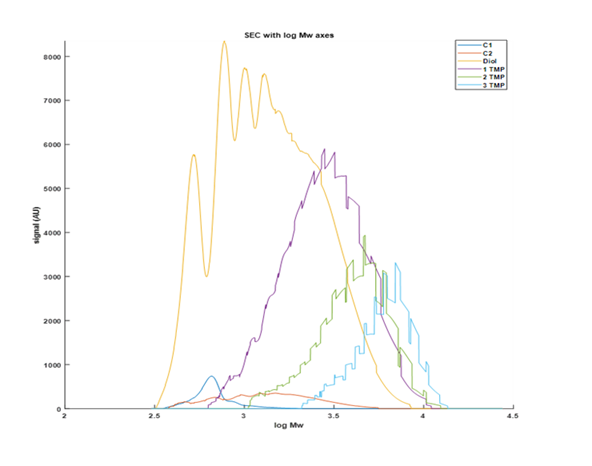
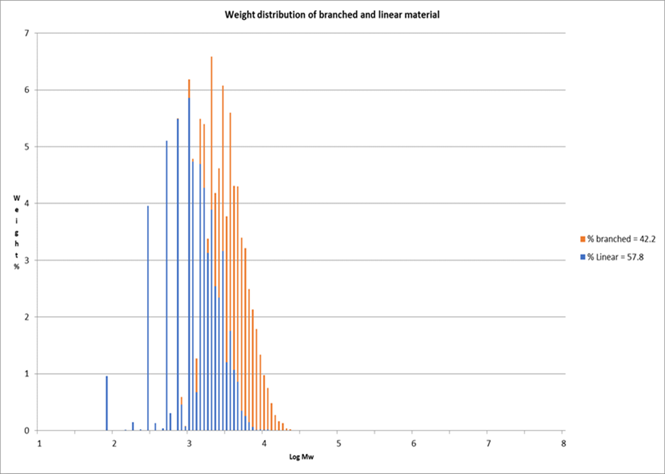
Upper image : Analysis result: %Branched:48.7, %Linear: 48.8
Lower image : Simulated result: %Branched:42.2, %Linear: 57.8
Continue
with the tour
|